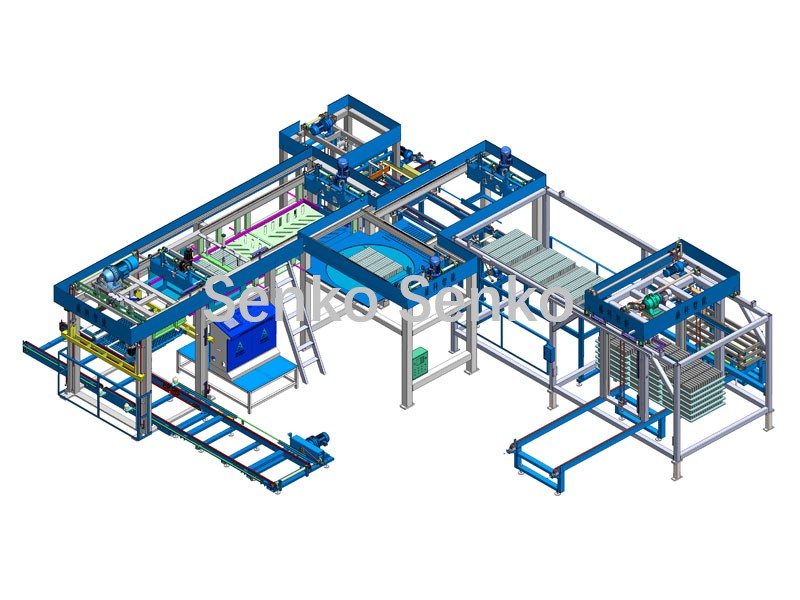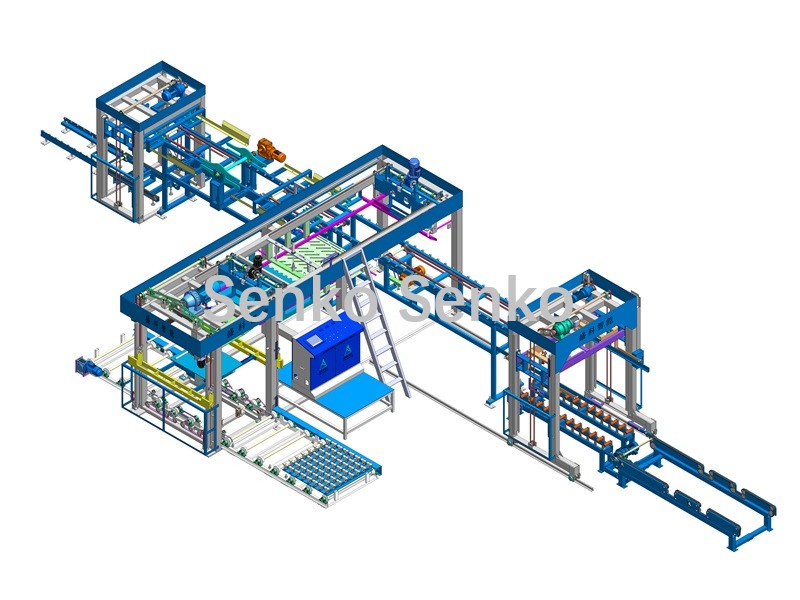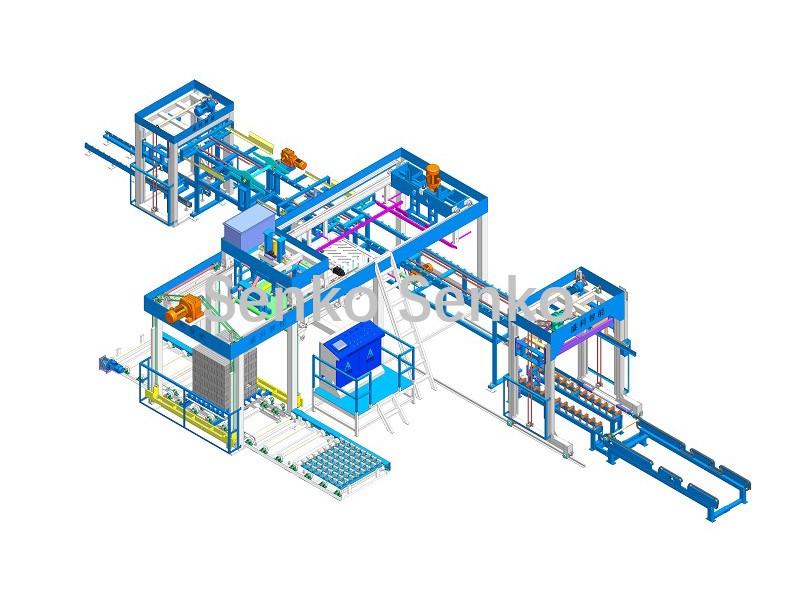
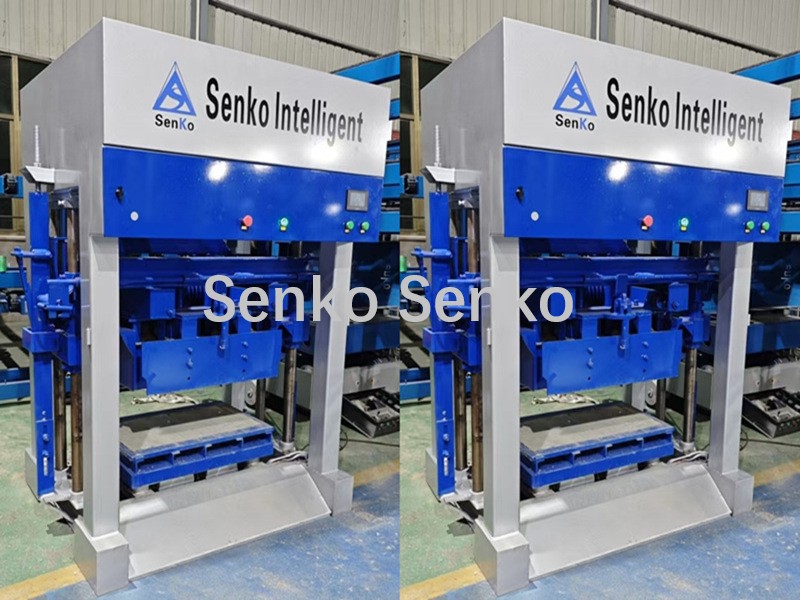
The intelligent brick and block stacker is an intelligent brick stacking equipment designed using patented technology with reserved gaps for stacking arrangement. This equipment brick/block stacking system solves the problems of manual stacking, high labor intensity, low production efficiency, and low mechanization of finished product loading and unloading in the current simple block production line. This equipment is the latest developed fast stacking system. In general, this system is independently placed near the product curing chamber. For well cured products, they can be stacked on site or connected to the block production line to achieve online stacking.
The upper-rotating, sword-piercing strapping machine is an automated strapping device specifically designed for bricks/blocks. It cleverly combines top-rotating and sword-piercing technologies to efficiently and securely strap brick stacks. The machine head (strapping mechanism) can move up and down along a vertical track, flexibly adapting to different stacking heights. Simultaneously, a rod-shaped mechanism called a "sword" precisely passes through the space at the bottom of the pallet from one side of the machine, working in conjunction with the machine head to complete the wrapping of the strapping, achieving a crisscross pattern of strapping to the brick stack.
The downward rotating, sword-piercing brick baling machine is an automated strapping device specifically designed for brick blocks. Its core actions are "downward rotation" and "sword piercing." Downward rotation: This refers to the baling head of the machine rotating downwards and moving, flexibly adapting to brick stacks of different heights to complete the strapping action. Sword piercing: A rod-shaped mechanism called a "sword" precisely passes through the reserved space at the bottom of the pallet from one side of the machine, guiding the strapping to the other side of the brick stack, cooperating with the baling head to complete the wrapping.
A film wrapping machine is a device used to automatically wrap finished products stacked on pallets with plastic film. Using LLDPE stretch film (a type of linear low-density polyethylene stretch film), the bricks are tightly wrapped around the pallet, providing fixation, preventing spillage, dust protection, and moisture protection. Controlled by a PLC (Programmable Logic Controller), it can automatically complete processes such as wrapping, lifting, and film cutting. The film holder typically has a pre-stretch function (pre-stretch rate up to 250%-300%), effectively saving film consumption. The packaging height and number of wrapping layers are adjustable to accommodate different brick sizes and packaging requirements.
A laminating machine is a specialized piece of equipment used to automatically cover the surface of bricks or blocks with a protective film. Its main purpose is to prevent surface abrasion, scratches, and contamination during brick stacking and transportation, thus ensuring the appearance quality of the product upon leaving the factory.Bricks enter the laminating area via a conveyor mechanism (such as a conveyor belt). A roll of protective film, pre-installed on a film roller, is drawn and unrolled through a series of guide rollers, covering the surface of the brick. Subsequently, a pressing roller and other mechanisms tightly press the film onto the brick. Some machines also employ heating elements (such as low-temperature heating rods) to slightly heat the film, making it more flexible and improving the lamination effect.Finally, the film is cut using a cutting device, completing a single coating process.
RGV (Rail Guided Vehicle) transport vehicles play a crucial role as efficient automated logistics hubs in brick block manufacturing plants. Through a pre-set network of fixed or flexible tracks, they precisely connect various production stages, such as brick presses, curing kilns, and stacking areas, enabling fully automated block transfer. Brick blocks are heavy, and the production environment is dusty and vibrating. RGVs are robustly constructed and designed for heavy loads and harsh conditions, enabling stable, long-term, uninterrupted operation.Relying on fixed tracks, RGVs can achieve very high stopping accuracy, which is essential for automated integration with brick presses, stackers, and other equipment, ensuring consistent production cycles.
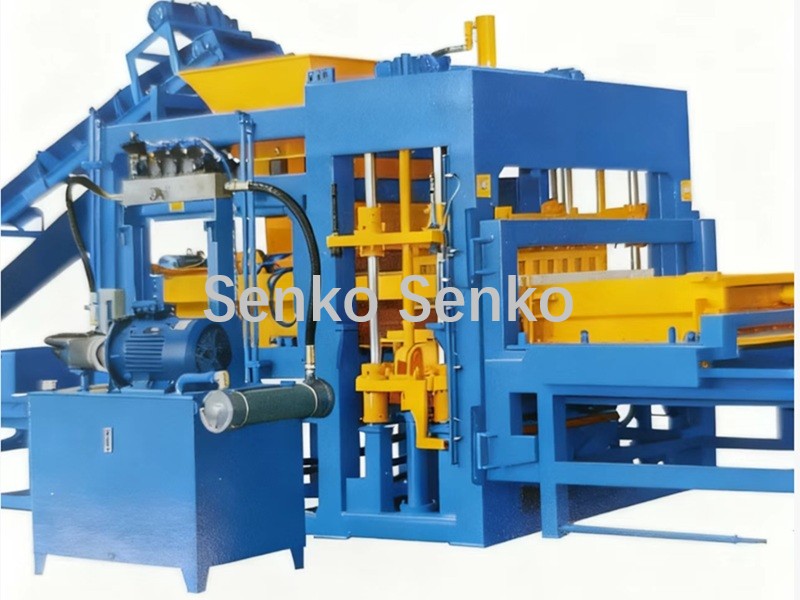
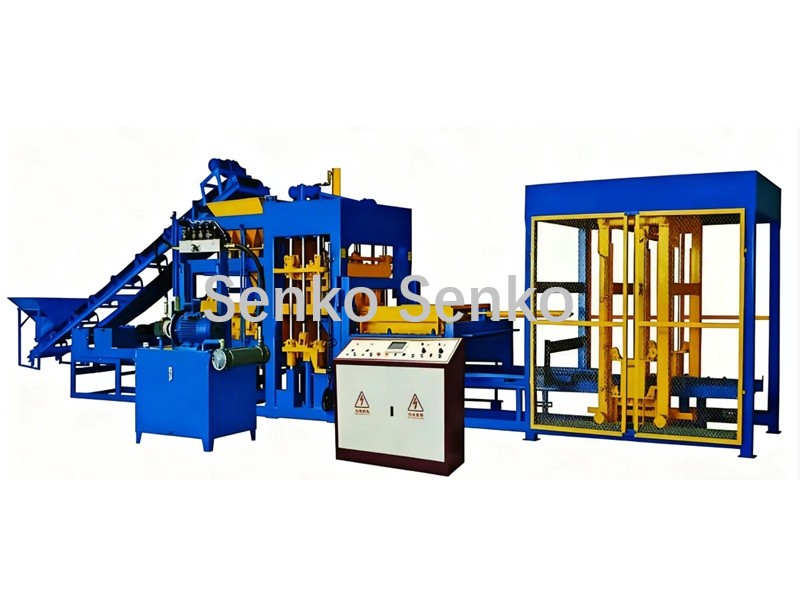
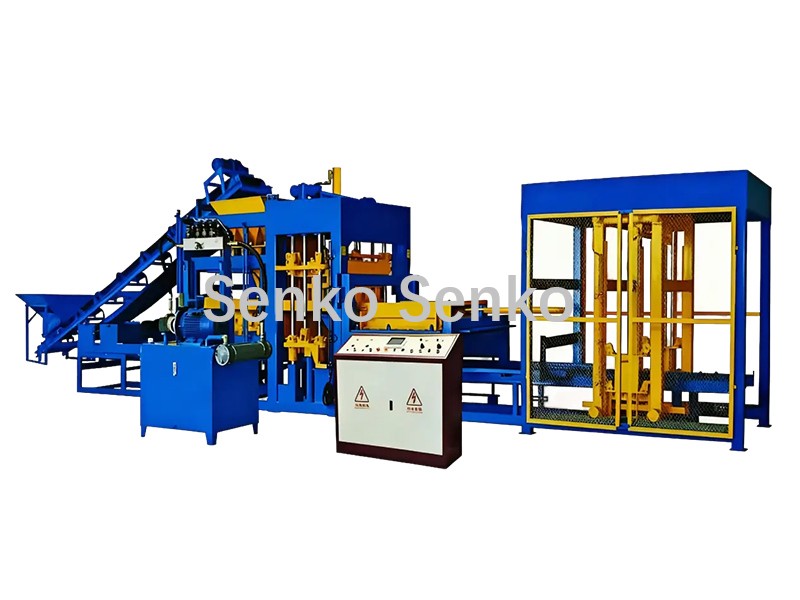
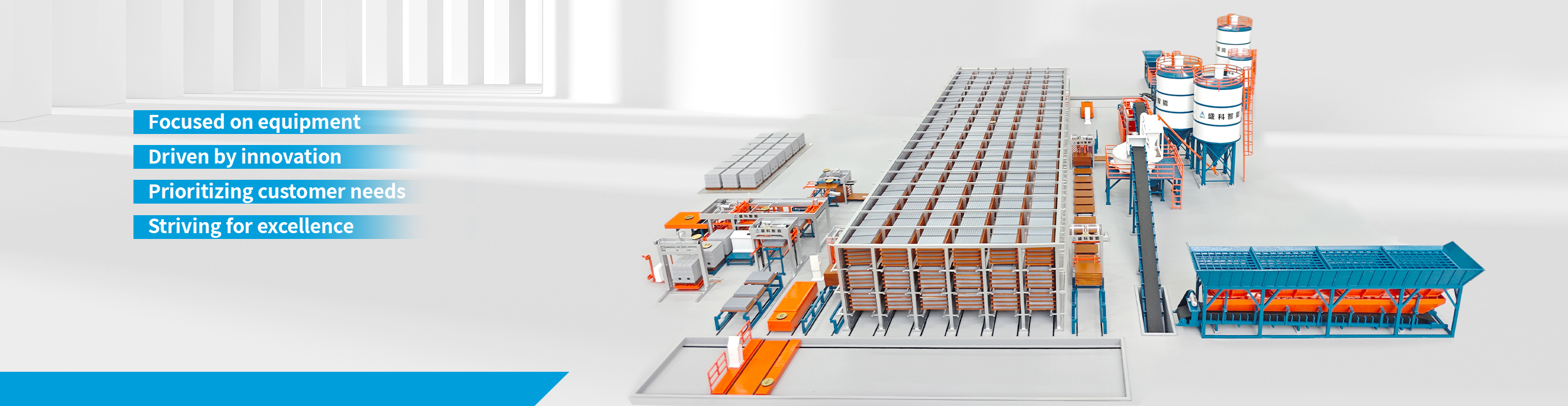
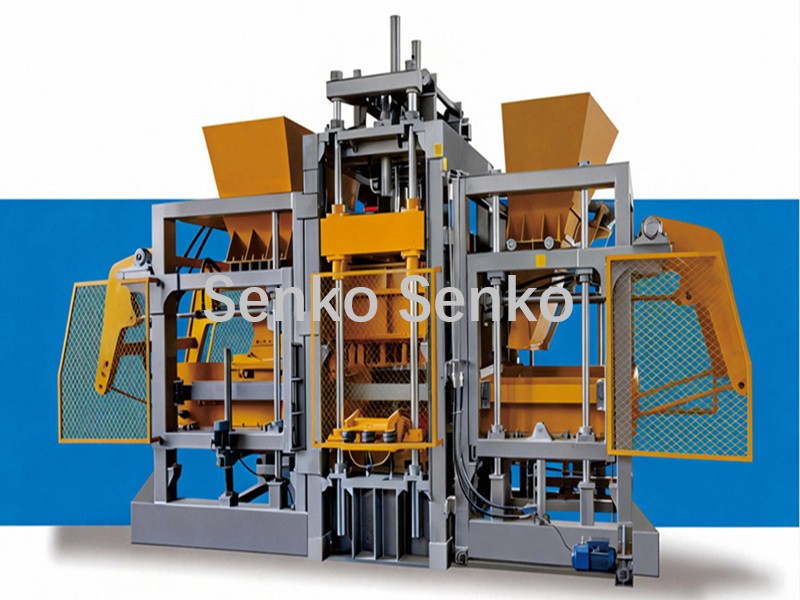
Using sand, gravel, and cement, and with the addition of large quantities of fly ash, slag, steel slag, coal ash, ceramsite, perlite, and other industrial waste, this machine produces various exterior wall blocks, interior wall blocks, PC imitation stone permeable bricks, decorative wall blocks, floor slabs, embankment blocks, interlocking blocks, curb stones, and other paving stones. A colored fabric application device can be added to produce colored paving bricks of various specifications.
Using sand, gravel, and cement, and with the addition of large quantities of fly ash, slag, steel slag, coal ash, ceramsite, perlite, and other industrial waste, we produce various exterior wall blocks, interior wall blocks, PC imitation stone permeable bricks, decorative wall blocks, floor slabs, embankment blocks, interlocking blocks, curb stones, and other blocks. We can also add a colored fabric application device to produce colored paving bricks of various specifications.