How a Fully Automatic Concrete Block Production Line Achieves Higher Output with Fewer Operators – A Look at the QT12 System
May 18, 2026
The concrete block manufacturing industry has long been characterized by labor-intensive processes, inconsistent output, and operational bottlenecks that limit scalability. Today, driven by rapid urbanization, infrastructure development, and rising labor costs, manufacturers across the globe are accelerating their transition toward fully automated production lines.
At the heart of this transformation lies a fundamental question: How can a concrete block production line simultaneously increase output and reduce workforce? The answer lies not in a single upgrade, but in a systems-level approach to automation that eliminates manual bottlenecks, standardizes quality, and optimizes every step from raw material batching to finished pallet stacking.
This article examines how the QT12 fully automatic block making machine, a widely adopted model in the concrete forming industry, enables manufacturers to achieve precisely this dual objective, supported by real-world operational examples.
---
The Automation Advantage: From Manual Dependency to Synchronized Production
The Traditional Labor Challenge
In a conventional manual or semi-automatic production setup, multiple operators are required for distinct tasks: raw material feeding, mixer control, mold operation, block demolding, forklift transport to the curing yard, stacking, and quality inspection. Each manual touchpoint introduces not only labor cost but also variability—inconsistent block density, breakage during handling, and production delays due to operator fatigue.
Studies of the block and paver industry have shown that traditional processes involving manual stacking, cube forming, and dispatch create processing bottlenecks, slow production cycles, increased breakage, inconsistent packaging, and reduced overall plant efficiency.
How Automation Transforms the Equation
A fully automatic block production line replaces these fragmented manual steps with a synchronized, technology-driven workflow. Programmable logic controllers (PLCs) govern the entire production sequence, receiving real-time signals from sensors and sending precise commands to actuators, hydraulic cylinders, and variable frequency drives. The result is a closed-loop system where the machine self-regulates, ensuring that every block in every cycle meets exact specifications.
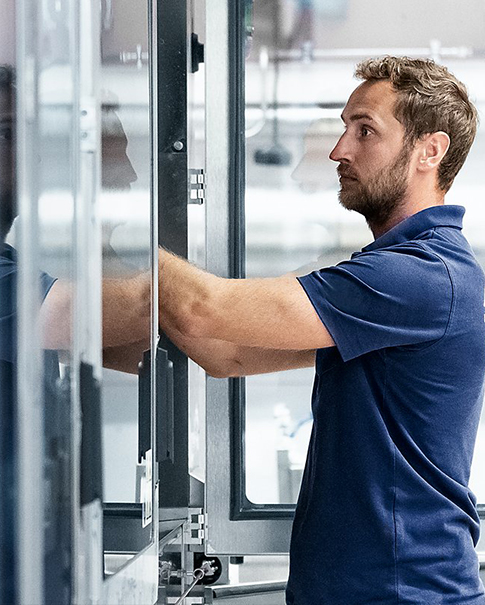
With full automation, operator involvement is minimized, the risk of human error is reduced, and maximum utilization of production capacity is achieved. The downstream process—collecting finished blocks, forming standardized cubes, stacking them with accuracy, and preparing them for dispatch—is transformed from labor-dependent manual work into a synchronized, high-efficiency cycle.
---
The QT12 System: Engineering Designed for Output and Efficiency
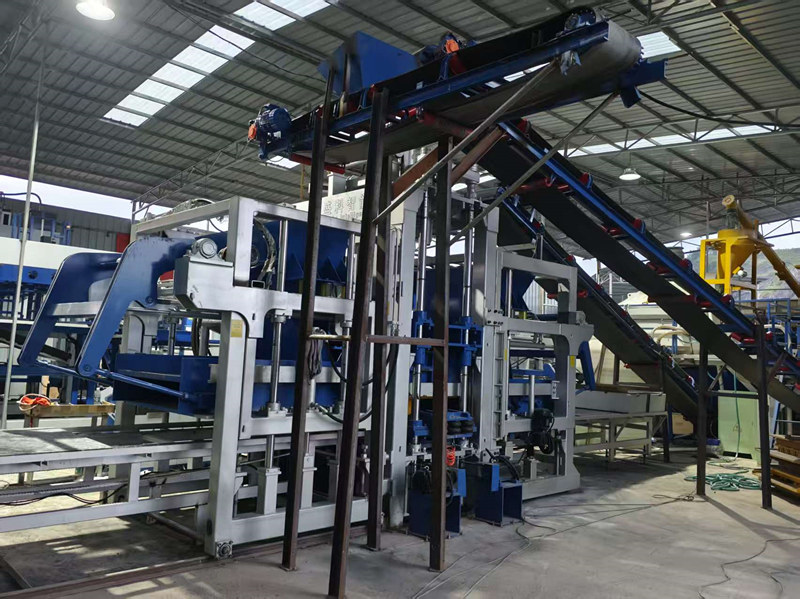
The QT12-15 automatic block making machine embodies the engineering principles that make automation effective in demanding production environments.
Key Technical Specifications
Parameter Specification
Overall Dimension 9350×2520×2950 mm
Pallet Size 1400×900 mm
Molding Cycle 15–20 seconds
Overall Power 56.2 kW
Vibration Force 100–130 kN
Total Mass 12 tons
Demolding Method Hydraulic
General Water Consumption 12 tons/day
Factory Area Required Approximately 1200 m²
Source: Technical specifications for QT12-15 automatic block making machine.
Production Capacity Benchmarks
The QT12 demonstrates remarkable output capabilities. For hollow blocks measuring 400×200×200 mm, the machine can produce 12 blocks per pallet, achieving approximately 2,160 blocks per hour and 17,280 to 19,440 blocks per 8-hour shift, depending on cycle time optimization. For different product types, production capacity ranges from 17,300 to 124,800 pieces per 8-hour day. These output levels are achieved consistently shift after shift—unlike manual operations where productivity fluctuates with workforce fatigue.
Automation Features That Drive Results
The QT12 system integrates several advanced automation features that directly contribute to the "higher output, fewer operators" equation:
1. PLC-based intelligent control. The entire production process uses a PLC aptitude control system with a human-machine interface (HMI), enabling easy analysis of system signals, fault diagnosis, and parameter settings. Operators can monitor and adjust production parameters from a central control panel, eliminating the need for manual intervention at each station.
2. High-performance vibration system. The computer-controlled flow pressure of the hydraulic system enables vertically synchronous vibration with frequency conversion and braking. This produces higher block density while using less cement and reducing reject rates—directly improving yield per input.
3. Automated feeding system. The cloth system adopts a semi-closed screen reticular rotational feeding unit that forces material into molds evenly and consistently, ensuring uniform product strength across every cycle.
4. Hydraulic loading and demolding. Fitted with a specialized hydraulic loading unit, the QT12 readily achieves mass and automatic production, saving a significant amount of labor, maintenance space, and operating capital. The hydraulic demolding method provides consistent release without block damage—a common problem in manual demolding.
5. Remote monitoring and diagnostics. The computer system includes fault diagnosis capability. With a remote control system, operators can achieve plant-wide monitoring, control, and diagnostics from a single location. This reduces the need for distributed personnel and enables faster troubleshooting when issues arise.
---
The Operational Transformation: From Many Hands to Fewer Operators
Real-World Labor Reduction
The transition from conventional manual or semi-automatic operations to a fully automatic QT12 production line yields dramatic labor savings. While an industrial-grade fully automatic block production line generally requires only three to five workers for supervision, quality control, and maintenance, a manual operation of comparable capacity might require a team of fifteen to twenty workers to manage the same tasks.
The labor reduction is not merely about headcount. In fully automatic closed-loop systems, the forklift driver for wet block transport can be eliminated entirely, as automated transfer systems move pallets directly into curing chambers. A closed-loop fully automatic block production line can operate with as few as two to three workers: a control room operator and an inspector. No forklift driver is required for wet block transportation—one less operator per shift, with no driver fatigue factor limiting output speed.
A Real-World Example: The Jiangxi Ji’an Project
In a recent installation in Ji’an, Jiangxi Province, Quanzhou Senko Intelligent Equipment Manufacturing Co., Ltd. delivered a complete QT12-based fully automatic block production line. Before the upgrade, the operation relied on conventional workflows with multiple manual stations. After commissioning, the fully automated QT12 production line processes raw materials through to palletized finished blocks with minimal human touchpoints. The customer now runs the fully automatic line with just three operators per shift—a substantial reduction from the previous staffing requirement. This is precisely the "higher output, fewer operators" outcome the project was designed to achieve.
How the Savings Add Up
Aspect Manual / Semi-Auto Fully Automatic (QT12)
Operators per shift 7–8 2–3
Daily output (8h) Variable, operator-dependent Consistent 17,000–124,800 pieces
Manual handling breakage Moderate Near-zero (automated transfer)
Quality consistency Operator skill-dependent Identical block-to-block
Shift changeover downtime Substantial Minimal (PLC recipe recall)
Workplace injury risk Higher (lifting, stacking) Low (automated handling)
Based on industry data, an automated batching plant integrated with a concrete block production line can reduce labor costs by as much as 40% while delivering a mix with minimal variation, allowing precise targeting of strength requirements and saving cement on every block.
---
The Economics: Return on Investment and Long-Term Benefits
Quantifiable Gains
The shift to automation generates returns across multiple lines:
Labor cost reduction. With 3–5 operators instead of 15–20, annual salary savings alone can often exceed the initial purchase price of the machinery over a five- to ten-year period.
Higher real daily output. A fully automatic line typically achieves 15–30% higher real daily output compared to open-loop systems, due to the elimination of forklift speed limitations, driver fatigue, and wet block damage.
Lower operating costs per block. Higher block density means less cement consumption per unit. Reduced breakage means more saleable output from the same raw material input. Automated curing control means faster cycle times and more batches per day.
Reduced waste and rework. Material consumption is accurately calculated, eliminating costly overuse and ensuring a consistent mix every time.
Improved workplace safety. With fewer manual handling tasks—stacking, lifting, transferring—the risk of workplace injuries drops significantly. This translates to lower insurance premiums and fewer production interruptions.
Return on investment horizon. For medium- to large-scale operations, the return on investment for a fully automatic block production line is often recovered within 1 to 3 years. In well-managed operations with favorable market conditions, some plants achieve ROI within 6 to 12 months.
The Competitive Advantage
Beyond direct cost savings, automation provides strategic benefits that are increasingly critical in today’s construction materials market. Automated lines can quickly switch between product types by recalling stored recipes—from hollow blocks to solid pavers to permeable bricks—without manual hardware changes. This versatility allows manufacturers to respond to shifting demand without costly downtime.
Moreover, as green construction practices gain momentum worldwide, automated block machines support sustainable production by optimizing raw material usage, generating less waste, and consuming less energy per unit of output. This positions automated plants favorably for government incentives and green building certification programs.
---
Why "More with Less" Matters More Than Ever
The global automatic block making machines market is growing strongly, from $1.61 billion in 2025 to a projected $2.4 billion by 2030. Major trends driving this growth include AI-optimized block production, fully automated manufacturing lines, robotic material handling systems, and data-enabled production monitoring platforms.
For manufacturers, the question is no longer whether to automate, but how quickly—and with which system. The manufacturer that continues to rely on manual processes will be at a competitive disadvantage in pricing, quality consistency, and production capacity.
The QT12 system demonstrates that fully automatic block production is not a distant future state but a present-day reality. With proven engineering, documented labor savings, and scalable output ranging from thousands to over a hundred thousand units per day, it offers a clear pathway from labor dependency to operational efficiency.
---
Conclusion: A Template for the Automated Plant
The goal of a fully automatic concrete block production line is straightforward: a stable, automated system that reduces human error while maximizing throughput, quality, and profitability. The QT12 achieves this through an integrated architecture of PLC-based control, high-performance vibration, hydraulic demolding, automated feeding, and remote monitoring—all working in synchronized harmony.
For the customer in Ji’an, Jiangxi, the result has been measurable: higher daily output, lower per-unit costs, and fewer operators on the production floor. The reduction in manual handling has also improved workplace safety and reduced breakage—benefits that extend beyond the direct labor savings.
As labor costs continue to rise globally and demand for construction materials accelerates, the business case for full automation strengthens with each passing quarter. The manufacturers who act now to implement fully automated QT12-based production lines will be the ones best positioned to capture market share, control costs, and scale efficiently in the years ahead.
About Quanzhou Senko Intelligent Equipment Manufacturing Co., Ltd.
Quanzhou Senko specializes in designing and manufacturing fully automatic concrete block and paver production lines. With a focus on servo-driven vibration, intelligent control systems, and robust construction, Senko delivers complete turnkey solutions to customers across China and international markets.
---
This article is based on technical documentation and operational case studies related to QT12 series automatic block making systems. For specific project consultations and performance data tailored to individual production requirements, please contact the equipment manufacturer directly.